
Tummy Tuck Scars: What You Really Need to Know Before Surgery

Categories
view more
One of the most common questions patients ask before committing to abdominoplasty is: “What will the scar look like?”
It’s a completely normal concern — abdominoplasty is a major procedure, and while the results can be transformative, the scar is a permanent part of the journey. The good news? With thoughtful planning, precise technique, and proper aftercare, the scar can be discreet, low, and beautifully healed over time.
Here’s everything you need to know.
Will I Have a Scar After Abdominoplasty?
Yes — any surgery involves a scar.
But what matters most is how well the scar is designed, where it’s placed, and how it heals.
In the first few months, the scar may appear pink or slightly raised. Over time, usually within 6–12 months, it fades into a softer, lighter line. With the right recovery plan, the scar becomes subtle and easy to conceal under underwear or swimwear.
Where Is the Scar Placed?
Scar placement is one of the most important aspects of the operation.
In my practice, I place the incision 6–7cm above the introitus — low enough that it sits naturally beneath most underwear and swimwear styles.
We customise the placement based on:
- your torso length
- the type of underwear or swimwear you prefer
- where your natural skin folds sit
This ensures the scar is easy to hide in everyday life, whether you’re in activewear or at the beach.
Can the Scar Be Customised for Me?
Absolutely — no two abdominoplasty scars are the same.
Every patient has different proportions, skin quality, and goals. I tailor the incision to your body, ensuring it sits comfortably and looks natural over time.
A carefully designed scar means a more harmonious, balanced result overall.

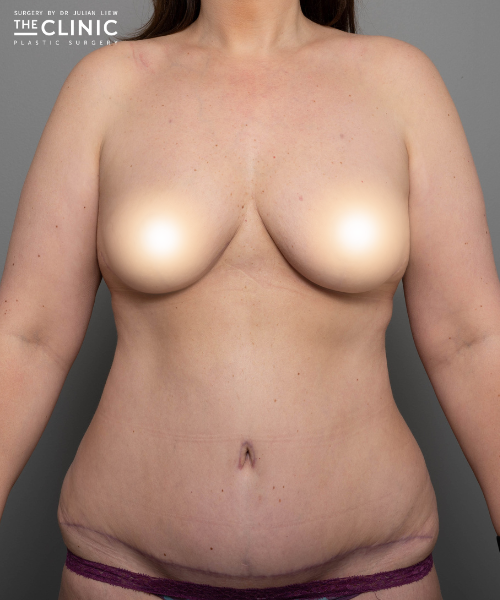
DISCLAIMER: All before and after photographs are actual cases of Dr. Julian Liew, and are examples only. All surgical results are subject to individual patient variability and do not constitute an implied or certainty for the result.
How Is the Scar Managed After Surgery?
At The Clinic Plastic Surgery, we use a structured scar-care protocol because early management makes a big difference.
Your scar management plan includes:
✔ Waterproof tape for 3 weeks
Protects the incision from moisture and friction during the initial healing stage.
✔ Silicone tape for another 3 weeks
Clinically proven to reduce redness, thickness, and firmness.
✔ Silicone-based cream + gentle massage
Used after taping to further soften and flatten the scar.
This staged approach helps the scar heal smoothly and predictably.
Can Laser Improve My Scars?
For some patients, scars heal beautifully on their own.
But if a scar is:
- raised
- firm
- darker than expected
- uneven in texture
—we offer fractional CO₂ laser treatment in-house.
This advanced laser stimulates collagen, improves texture and colour, and helps the scar blend more seamlessly with the surrounding skin.
Having laser available means you’re supported at every stage of healing — without needing to seek external treatments.
How Long Does It Take for the Scar to Fade?
Scar maturation is a slow, natural process.
Here’s what to expect:
- 0–3 months: Pink, firm, slightly raised
- 3–6 months: Starting to soften and lighten
- 6–12 months: Continued fading and flattening
- Up to 24 months: Final refined appearance
With proper technique and aftercare, most patients end up with a fine, pale line that does not distract from their abdominoplasty results.
Considering Surgery?
Understanding the scar is an important part of the decision.
If you’re considering abdominoplasty and want personalised advice on scar placement, healing, and recovery, I’d be happy to guide you.
Enquiry Now
DR JULIAN LIEW TALKS
What Should I Know About Scars After Abdominoplasty?
A Clear Guide by Dr Julian Liew, Specialist Plastic Surgeon
MORE ABOUT THIS PROCEDUREDr Julian Liew, Reconstructive & Plastic Surgeon
Dr Julian Liew is a highly qualified, Australian-trained Specialist Plastic and Reconstructive Surgeon certified by the Royal Australasian College of Surgeons.
Dr Liew is committed to surgical excellence and Plastic and Reconstructive Surgical training. Currently he is the Clinical Lead of Breast Reconstruction and the Supervisor of Plastic Surgery Training at Austin Health. He is also a Clinical Trainer at The Royal Australasian College of Surgeons.
Julian’s subspecialty interest is in Microsurgery and Breast Reconstruction Surgery. In order to further his expertise, Julian completed a fellowship in these specialty areas at the world-renowned Queen Victoria Hospital in East Grinstead, United Kingdom.
As a skilled Microsurgeon and Specialist Plastic Surgeon his attention to detail and to the skill and precision of the procedure is only paralleled by his passion for the patient-centric experience and his complete involvement along with his talented team, through the patient’s entire surgical journey.
Dr Liew is committed to surgical excellence and training future plastic surgeons at Austin Health, where he is the Clinical Lead of Breast Reconstruction and the Supervisor of Plastic Surgery Training. He is also a Clinical Trainer at The Royal Australasian College of Surgeons.


Why Choose The Clinic
Four simple reasons
{{el.headline}}
{{el.description}}